
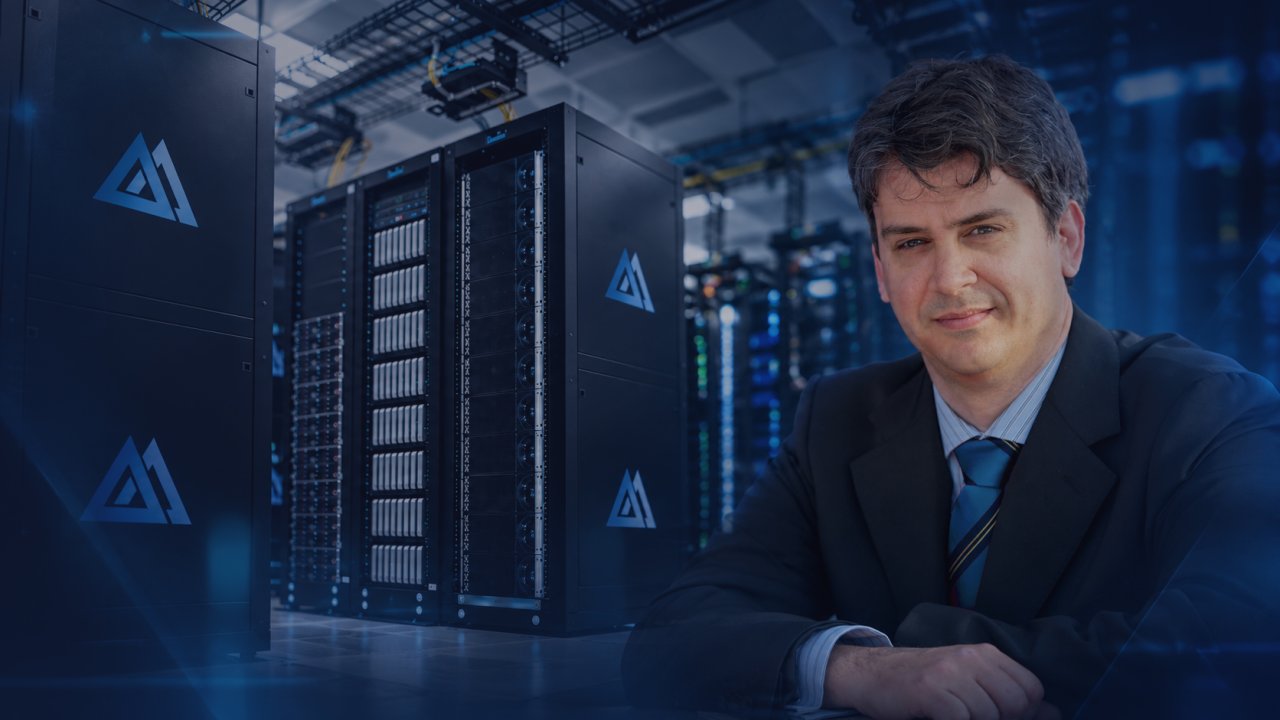
The Italian scale-up, which designs, builds and operates energy-intensive data centers across four continents, has appointed Turnbow to lead its technical expansion into artificial intelligence and high-performance computing. Its energy-to-compute approach aims to harness renewable energy and reuse existing assets to support the more sustainable development of compute infrastructure.
Trento, 15 October 2026 — ALPS, the Italian scale-up that designs, builds and operates energy-intensive data centers, announces the appointment of Brian Turnbow as Technical Director for AI. Founded in Trentino in 2018 and now operating in Italy, Oman, the United States and South America, the company has developed compute infrastructure integrated with energy systems and is now beginning a gradual expansion into data centers for artificial intelligence and high-performance computing.
The growth of AI requires new data centers with ample power, grid connections, cooling systems, reliable operations and predictable delivery timelines. According to the International Energy Agency’s 2025 Energy and AI report, around 20% of planned data center projects could face delays due to grid constraints. In Italy, Terna data as of 31 August 2026 showed that data center grid connection requests totalled more than 100 GW, up from around 30 GW at the end of 2024. There is a risk that some of the announced capacity will not be built and commissioned on schedule.
ALPS plans to develop AI and HPC projects alongside its ongoing mining operations, drawing on its experience in building and operating data centers for energy-intensive computing workloads. Its energy-to-compute model is based on a deliberate choice: locating data centers where energy is already available, at or near generation sites, rather than concentrating new demand exclusively in major hubs. The aim is to reduce reliance on congested areas of the grid and the associated connection queues, developing capacity at sites where power availability, grid infrastructure and operating conditions allow for more predictable delivery timelines.
Sustainability is integral to this development approach. ALPS aims to make use of energy that is already available, prioritizing integration with renewable sources, and to reuse existing grid connections, buildings and industrial assets wherever technically feasible. Redeveloping disused sites can limit land take and reduce the need for new construction, bringing existing local resources back into productive use. Alongside the use of renewable energy, asset reuse can support the more sustainable development of compute infrastructure. The aim is to combine growth in computing capacity with more efficient use of energy resources and industrial assets.
In his new role, Turnbow will lead the development of ALPS’s technical strategy for artificial intelligence and high-performance computing. His remit will include assessing infrastructure requirements, architectures and sites, engaging with technology and industrial partners, and developing a scalable operating model for building next-generation data centers.
Italy will be a priority market for development. ALPS intends to bring the expertise it has gained internationally back to Italy to support new AI and HPC projects. It will work with Italian engineering and industrial companies, drawing on their expertise in projects both in Italy and abroad. This approach can help expand Italy’s computing capacity and support the international growth of its engineering and industrial supply chain. Project development will involve collaboration and dialogue with local and national authorities, including the relevant ministries.
“AI is also an infrastructure challenge: it requires ever-closer integration between energy and computing capacity,” says Francesco Buffa, CEO and co-founder of ALPS. “Italy and Europe have energy resources, industrial assets and technical expertise that can support this growth. The challenge is to harness these strengths and work with the industrial supply chain to develop new computing capacity that helps narrow Europe’s AI gap. Through our energy-to-compute approach, we want to turn the energy and industrial potential of the regions in which we operate into a competitive advantage in developing AI and HPC infrastructure.”
Originally from California, Turnbow has worked in Italy since 1997 and has over 25 years’ experience in telecommunications and digital infrastructure. Throughout his career, he has held senior technical roles at Italian providers of network, data center and cloud services, including TWT, Unidata and CDLAN. He also serves on the board of ITNOG, the Italian Network Operators Group.
“AI infrastructure starts well before GPU deployment,” says Brian Turnbow, Technical Director for AI at ALPS. “Every project must start with the workloads it needs to support and the requirements of its users, not just the available power. At ALPS, my goal is to translate these requirements into coherent design decisions, building flexible, scalable and sustainable computing capacity while making use of renewable energy sources and existing assets wherever they are compatible with the project’s requirements.”

