

Bitcoin Mining: Sustainability, Innovation and Strategy
Bitcoin mining has changed. What was once a niche activity carried out by pioneers and enthusiasts has become a global industry involving institutional players, closely linked to the energy sector and driven by increasingly sophisticated technologies.
So, what does the industry look like today? The Cambridge Digital Mining Industry Report (April 2025) provides a detailed and up-to-date snapshot, based on data from 49 companies representing nearly 50% of Bitcoin's global hashrate.
Published in April 2025 and presented by its author during the Bitcoin Conference at the end of May, the report also included Alps Blockchain among the companies contributing data.
The Heart of the Bitcoin Network: Sustainability and Energy Consumption
According to the report, global Bitcoin mining consumes approximately 138 TWh of electricity per year, generating around 39.8 million tonnes of CO₂ equivalent. While significant, this accounts for only 0.08% of global greenhouse gas emissions.
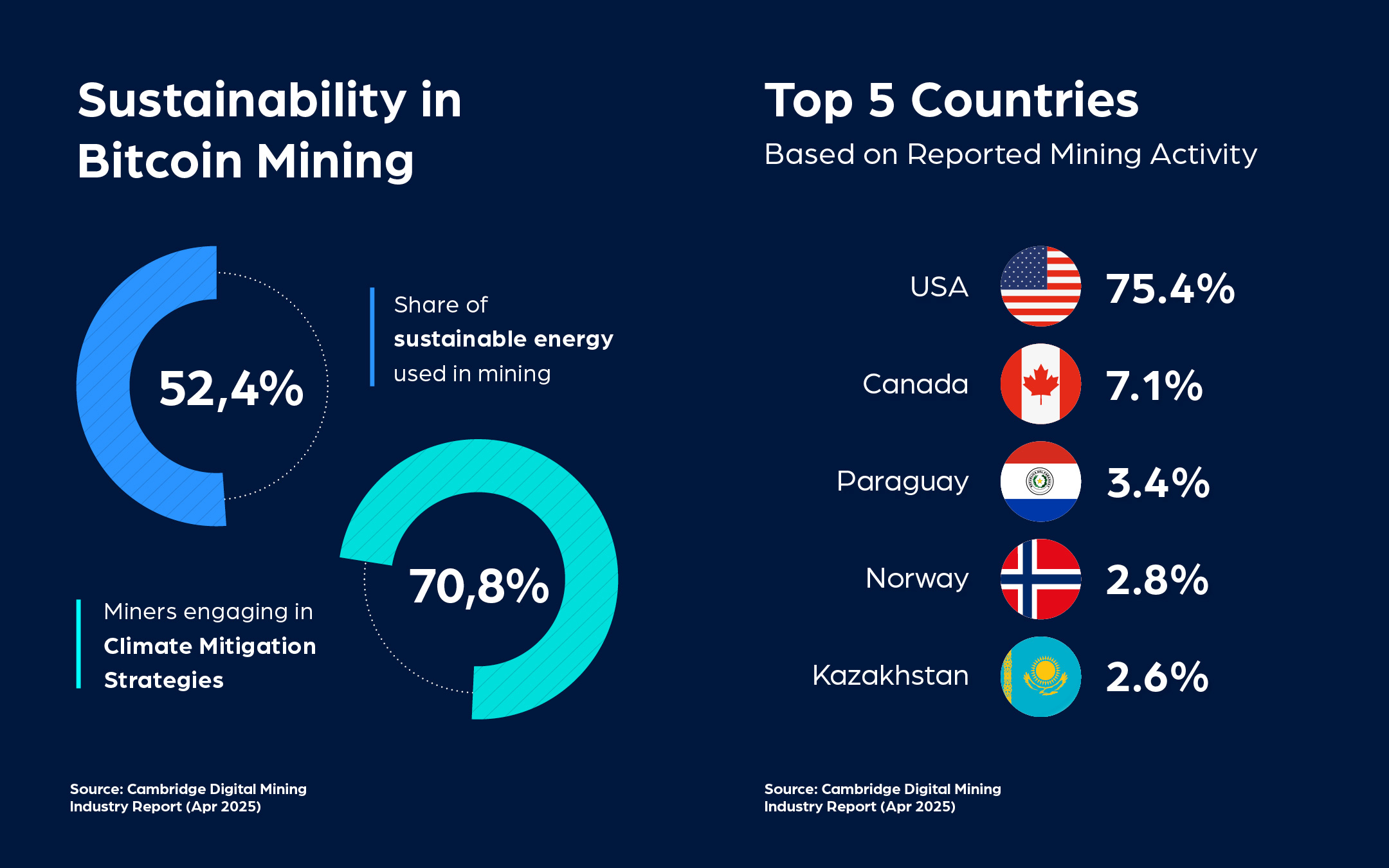
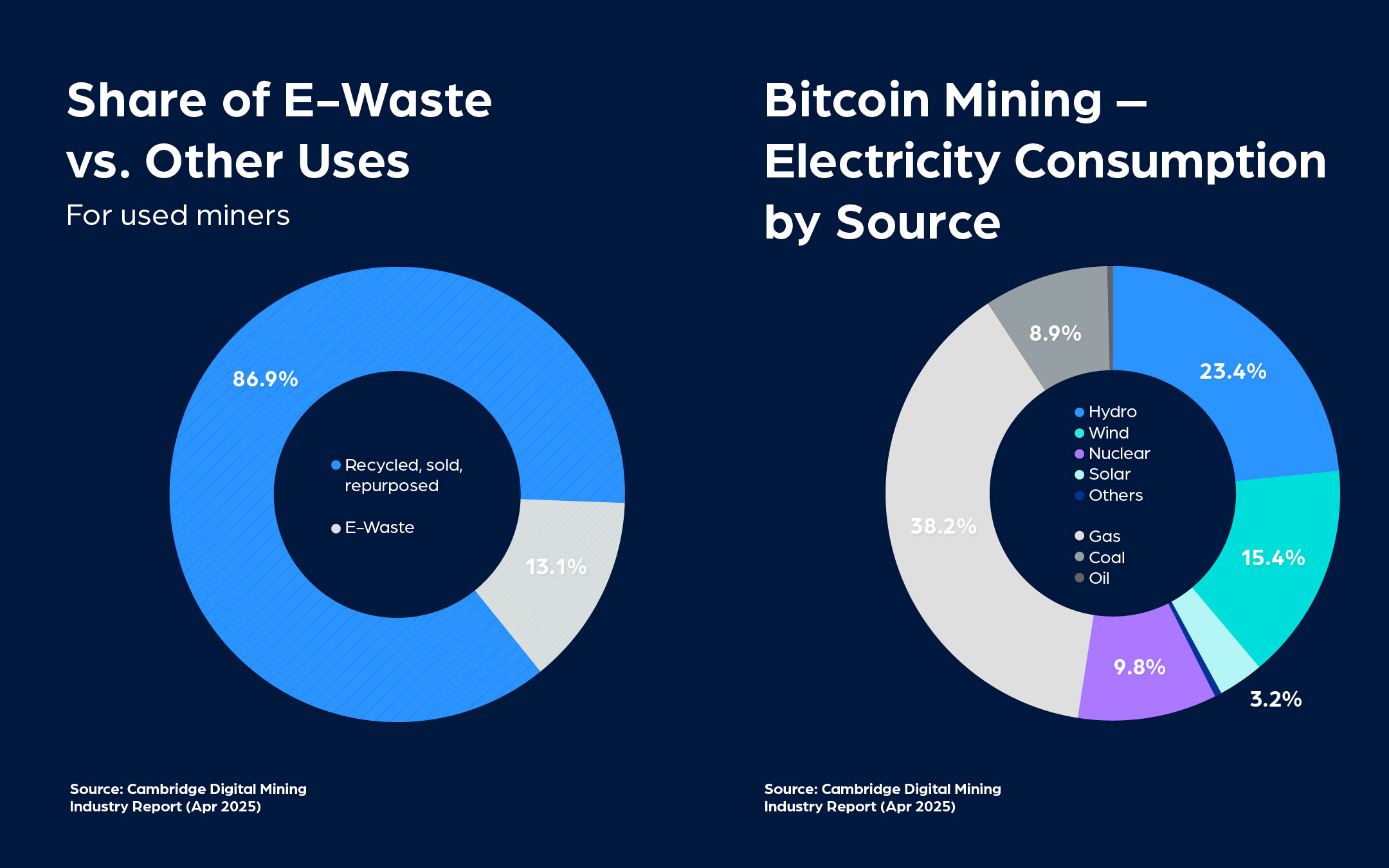
Even more noteworthy is the sustainability data: 52.4% of the energy used by Bitcoin miners comes from sustainable sources, with hydropower accounting for the largest share (23.4%), followed by wind (15.4%) and nuclear energy (9.8%). Natural gas remains the single most widely used energy source (38.2%), but the industry is steadily moving toward cleaner solutions: more than 70% of surveyed miners reported implementing concrete climate mitigation measures.
Efficiency and Innovation: Mining Becomes Smarter
The report highlights significant improvements in mining efficiency. ASIC hardware has reached an average efficiency of 28.2 J/TH, representing a 24% improvement compared to the previous year.
This progress not only reduces energy consumption per unit of computing power but also reflects a growing commitment to the circular economy: nearly 87% of decommissioned hardware is recycled or repurposed, helping reduce the environmental impact of electronic waste.
The United States Leads, but New Regions Are Emerging
The United States continues to dominate the global mining industry, accounting for more than 75% of the reported hashrate, followed by Canada (7.1%). However, the report also highlights growing activity in Latin America, the Middle East and Northern Europe.
Geographical diversification is not merely an operational choice—it has become a key risk management strategy. In an industry heavily exposed to volatile energy prices and regulatory uncertainty, 55% of miners consider international diversification a critical strategic asset.
Risks, Strategies and Market Outlook
The biggest concerns for mining companies remain energy prices (57%) and regulatory uncertainty (47%). To address these challenges, companies are increasingly adopting hedging strategies (60%) and, in some cases, expanding into complementary business models.
An increasing number of operators are exploring opportunities in compute-intensive sectors such as High Performance Computing (HPC) and Artificial Intelligence (AI), leveraging their existing infrastructure.
The surveyed miners also proved to be fairly accurate in their market forecasts. They estimated Bitcoin would end 2024 at around $80,500 (compared with the actual price of $93,390) and projected a global hashrate of 750 EH/s, versus the actual 796 EH/s.

